 Skip to content


Resin Kitchen Floors
The kitchen is the hardest working floor in your home: dropped pans, hot splashes, red wine, muddy dogs, and hundreds of crossings a day. It is also the room where a seamless floor makes the biggest visual difference, flowing unbroken around islands, under units, and out into open-plan living space with no grout lines, no joins, and no thresholds.
At The Resin Floor Co. we have been installing poured resin and microcement kitchen floors across London, Essex and the South East for over 14 years. Every floor is poured in situ by our own team, which is why the detailing where your floor meets kitchen furniture, stairs and walls is clean and precise. Get a free quote or call us on +44 20 7096 8990.
Why choose a resin floor for your kitchen?
Hygienic and easy to live with. A resin kitchen floor is completely non-porous. Spills, grease and bacteria stay on the surface and wipe away; there are no grout lines to scrub or stain. Our systems are also hypoallergenic, with nowhere for dust mites or allergens to collect.
Waterproof. Poured resin is impervious to water, so splashes around sinks and dishwashers are a non-event rather than a slow disaster.
Warm and quiet underfoot. Unlike tiles, a resin comfort floor has a slight elasticity that feels warm and silky underfoot, and it pairs perfectly with wet or electric underfloor heating.
Genuinely UV stable. This matters in kitchens, which are usually the brightest room in the house. The majority of our systems are aliphatic polyurethane, which does not yellow in sunlight. Many cheaper epoxy-based systems do; see below.
Seamless around any layout. Because the floor is poured as a liquid, islands, curved units, larders and awkward corners are simply flowed around. No cuts, no joints, no thresholds into the dining space.
Repairable and refinishable. Years from now, your floor can be sanded and recoated to bring it back to new, or to change colour entirely. We offer a full maintenance service for every floor we install.
Epoxy or polyurethane kitchen floor?
Searches for epoxy kitchen floors are common, and epoxy is a superb material in the right place: garages, plant rooms, and our high build commercial systems. But for domestic kitchens we usually recommend a polyurethane (PU) resin, and the reason is sunlight. Standard epoxy resins are not UV stable: in a bright kitchen they amber and yellow over time, especially in pale colours. Our aliphatic PU systems hold their colour permanently, flex slightly with the substrate (important over timber floors and underfloor heating), and feel warmer and softer underfoot.
If you have been quoted for an epoxy kitchen floor elsewhere, ask the installer one question: is the topcoat aliphatic and UV stable? If they cannot answer, ask us instead.
Which system is right for your kitchen?
- Resin Comfort Floors: smooth, silky, one flat colour (any RAL). Best for modern open-plan kitchens, underfloor heating and families.
- Corques Liquid Lino: natural cork-based, warm and sustainable. Best for eco-conscious projects and softer, muted palettes.
- MicroCrete Microcement: the polished concrete look with natural variation. Best for industrial and rustic looks, and installs over existing tiles or screed.
- Kerakoll Cementoresina: designer cement-resin hybrid with an Italian palette. Best for architect-led projects matching walls and floors.
Not sure? Send us a photo of your kitchen with the quote form and we will recommend the right system honestly, including when we would not recommend resin.
What does a resin kitchen floor cost?
Every kitchen is different, but the honest factors that set the price are: the floor area in square metres (smaller areas cost more per square metre because set-up is fixed), the condition of the existing substrate (timber, screed, tiles and anhydrite all need different preparation), the system chosen, edge detailing around islands and units, and your location. As a guide, budget from £140.00 + VAT per m2 for MicroCrete and from £135.00 + VAT per m2 for a poured PU comfort floor, with most domestic kitchens completing in 4 to 7 days depending on the individual systems and build ups. For a precise figure, our quick estimate system takes two minutes. For more on what affects the price, see our microcement and resin flooring cost guide.
Recent kitchen projects
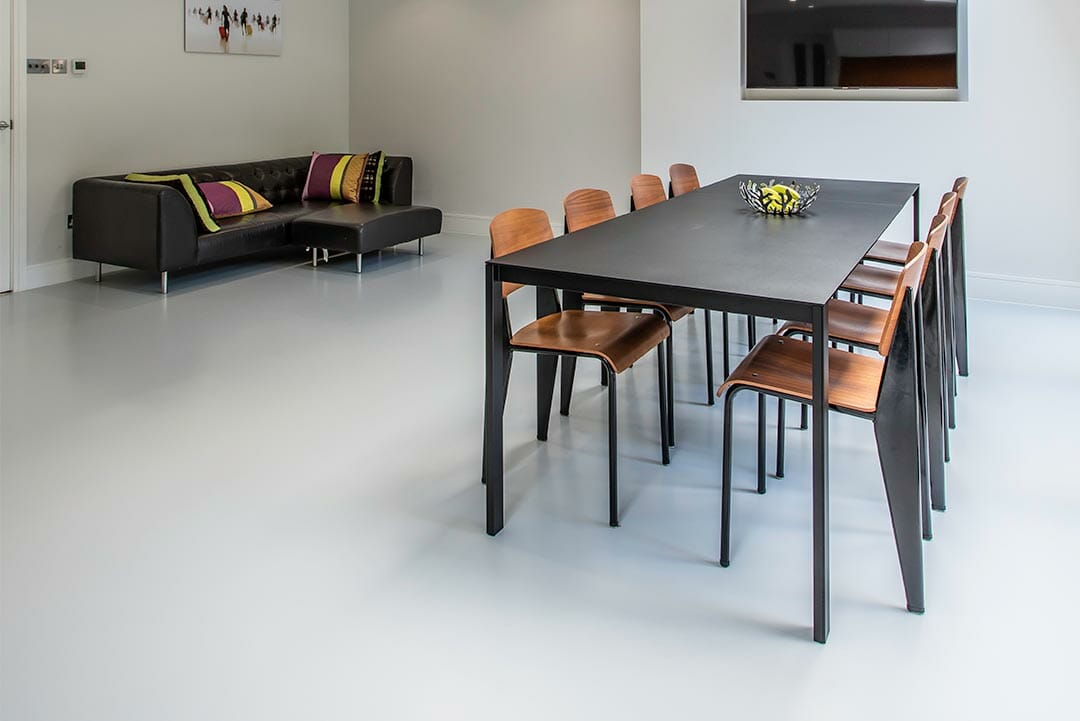
White kitchen diner, South West London
Resin Comfort in white over an existing screed with wet underfloor heating. Seamless from kitchen through dining space for a busy family home.

Architect designed home, Stepney Green
PU resin acoustic comfort floor in RAL 7040 through kitchen and living areas, with a poured resin staircase. With Alan Power Architects; photography Hufton and Crow.
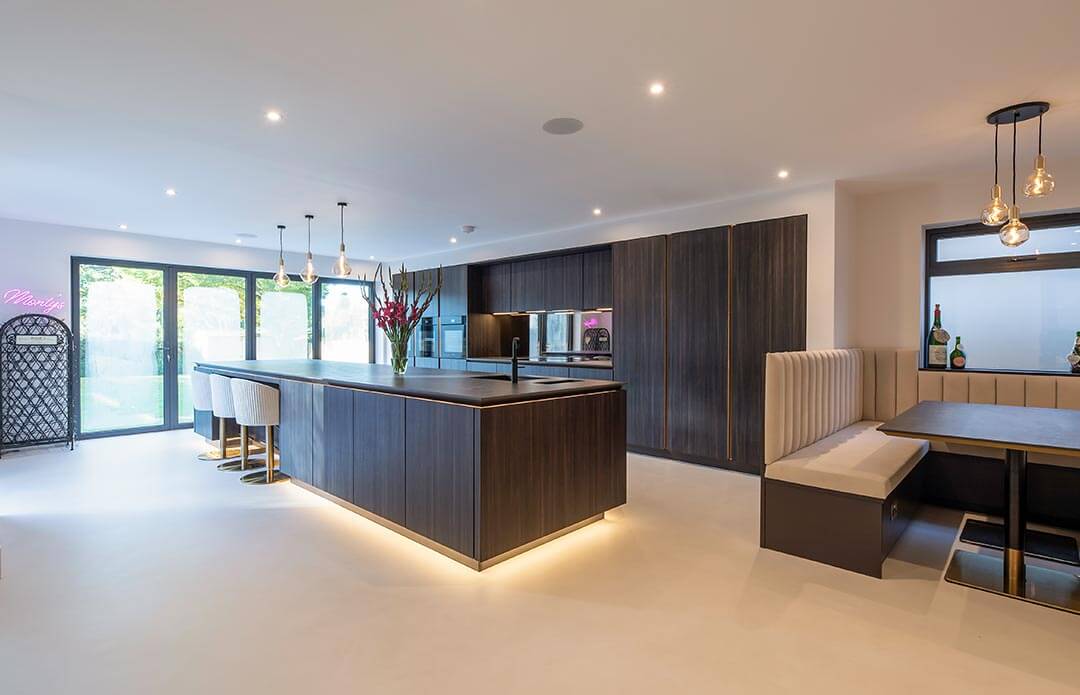
Kerakoll Cementoresina, Brentwood
180 square metres of Cementoresina in WR02 grey across the whole ground floor including the kitchen, over commissioned underfloor heating.
“We would like to express our thanks to the whole team at the Resin Floor Company for our beautiful floor… Jason was extremely knowledgeable and ran through lots of options.” – Gemma Castley, Google review (5.0 rating from 22 reviews)
Resin kitchen floor FAQs
Is a resin kitchen floor slip resistant?
Yes. Finishes can be specified from smooth satin through to enhanced slip resistance, and we advise on the right balance for family kitchens: fully anti-slip textures are harder to clean, so most domestic kitchens choose a mid-point.
Can you install over my existing tiles or timber floor?
Usually, yes. With correct preparation our systems install over tiles, cement screed, concrete, plywood and timber, and anhydrite screeds. Timber substrates need a flexible system, and our comfort floors are ideal. We assess the substrate at survey rather than guessing.
Will it scratch, chip or stain?
Resin floors are hard wearing but not indestructible: a dropped cast iron pan can mark any floor. The difference is repairability: scratches and wear can be sanded and resealed rather than the floor being replaced. Staining is not a practical concern on a sealed resin floor; wine, oil and turmeric wipe off.
Does it work with underfloor heating?
Yes, both wet and electric systems. Our poured floors are specifically suited to modern underfloor heating and will not delaminate or crack with normal thermal cycling.
How thick is the floor? Will my doors still fit?
Very little. Poured resin systems are typically 4-8mm thick and microcement 2-4mm, depending on the system and the build-up your substrate needs. In most refurbishments doors and appliance heights are unaffected; we confirm the exact build-up at survey.
How long does installation take?
4-7 days for a typical domestic kitchen depending on system and preparation; microcement systems take longer than poured resin because each layer cures overnight. We sequence around your kitchen fitters when the floor is part of a bigger project.
How do I clean a resin kitchen floor?
A soft brush or vacuum and a damp mop with a pH-neutral cleaner. No special products, no sealing regime, no grout brushes. See our resin floor cleaning guide.
Can I have any colour?
Yes: any RAL or NCS colour, and we can custom match popular paint palettes. MicroCrete and Kerakoll systems have their own natural palettes, and MicroCrete can also be colour matched to most popular paint colours.
Get a fast, honest quote for your kitchen. Get a quote or call +44 20 7096 8990.
See this in action: a recent microcement kitchen and living space installation — view the project.
