 Skip to content


Microcement Bathrooms & Wet Rooms
Seamless, grout-free floors and walls for bathrooms, showers and wet rooms
No grout lines to scrub or re-whiten. No tile edges. One continuous surface flowing across the floor, up the walls, and straight through the shower. Microcement has become the defining look of modern bathroom design, and bathrooms are where we install it more than anywhere else.
At The Resin Floor Co. we have installed microcement bathrooms and wet rooms across London, Essex and the South East for over 14 years, from family en suites to the bathroom walls of the Italian Embassy in London. Get a free quote or call +44 20 7096 8990.
The honest bit first: waterproofing is everything
Most microcement bathroom failures you may have read about have nothing to do with microcement. They happen because the installer skipped or skimped the tanking (waterproofing) layer underneath. Microcement itself is water resistant; the system it sits on must make the room waterproof.
We published a detailed guide to NHBC guidance for microcement and resin in bathrooms and wet rooms because we believe specifiers and homeowners should understand what correct installation looks like: a full tanking system beneath the microcement, correct falls to drainage in wet rooms, movement provision at junctions, and commissioned underfloor heating before installation, in accordance with British Standards. If a quote you are comparing is much cheaper than ours, ask what tanking system it includes. That is usually the answer; that, or corners are being cut in the layers and application process, which is how failures and very unhappy customers happen.
Why microcement in a bathroom?
One material, every surface. Floors, walls, shower enclosures, bath surrounds and vanity units in the same seamless finish. This is the thing tiles simply cannot do, and it makes small bathrooms feel dramatically bigger.
No grout. Nothing to discolour, no mould lines to bleach, no regrouting in five years. A wipe with a pH-neutral cleaner is the entire maintenance regime.
Fully waterproof as a system. Correctly tanked and sealed, a microcement wet room is watertight from substrate up.
Warm and safe underfoot. Pairs beautifully with underfloor heating, and sealers can be specified with enhanced slip resistance for wet floors.
Thin build-up. At 2-4mm, microcement goes over existing tiles or screed in refurbishments without ripping the room back to brick or raising floor levels.
Where we install it
Bathroom floors, bathroom walls, walk-in showers and wet rooms, bath panels and surrounds, sinks and vanity tops, and continuations into bedrooms or hallways for that unbroken designer look. And where we would not install it: where there is unresolved movement in the substrate, or where the existing surface is hiding a problem, such as tiles with underlying water damage. Applying a beautiful finish over a fault does not fix the fault; it always comes back. We will tell you honestly if a substrate needs resolving first, which is exactly what our survey is for, and why remediation projects like this one exist.
Which system?
- MicroCrete Microcement: our trademark microcement, with a natural palette and colour matching to most popular paint colours.
- Kerakoll Design House: the Italian designer range. Wallcrete and Patina for walls, Cementoresina for floors; we are the UK’s longest-established Kerakoll partner.
Epoxy-based microcements exist and are sometimes quoted by others for bathrooms; read our guide to UV stability of epoxy-based microcements before accepting one for a bright bathroom with lots of natural light.
What does a microcement bathroom cost?
Bathrooms are smaller than kitchens but more intricate: walls, enclosures, junctions and tanking mean more edge detail per square metre. Honest pricing factors: floor and wall area, the tanking system required, whether we are going over existing tiles or fresh screed, the number of internal corners and enclosures, and drainage falls in wet rooms. As a guide, budget from £4,000 + VAT upwards, with a typical bathroom or wet room taking 5-10 days, depending on size and complexity, including tanking and curing. For a precise figure, our quick estimate system takes two minutes. For more on what affects the price, see our microcement and resin flooring cost guide.
Recent bathroom projects

Italian Embassy bathrooms, London
Kerakoll bathroom wall finishes throughout the Italian Embassy in London: seamless, grout-free surfaces specified for a landmark diplomatic building.
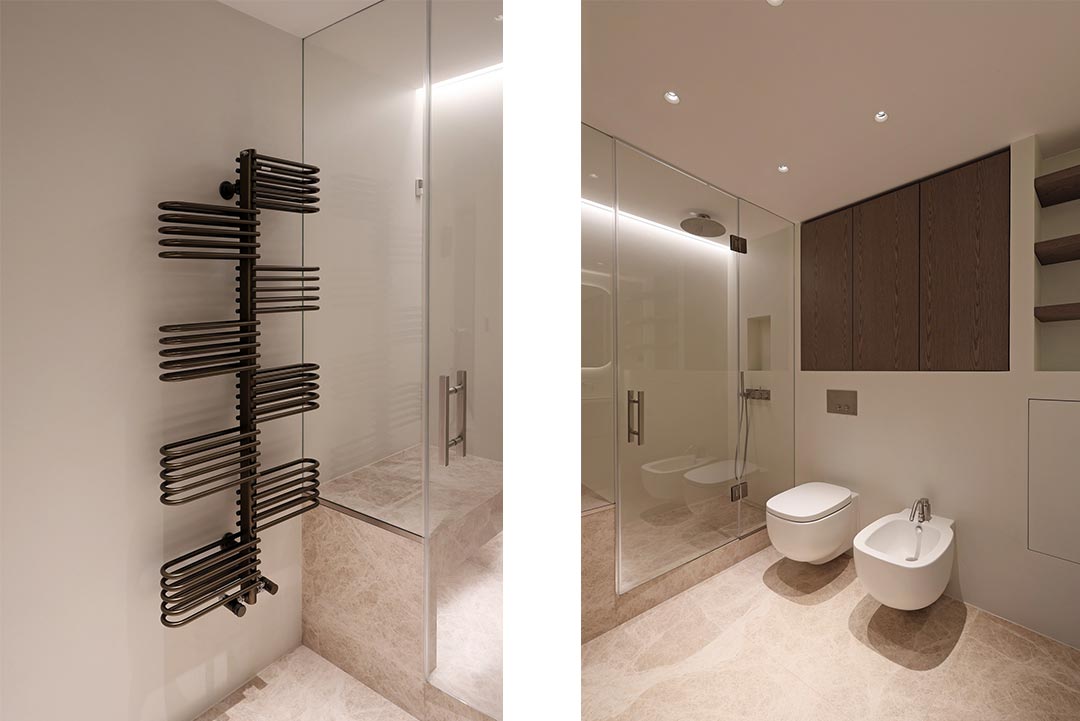
Wallcrete bathroom, Kensington penthouse
Seamless Wallcrete WR01 across the master walls, twin basins and through the walk-in shower, fully tanked to NHBC guidance.
Microcement bathroom FAQs
Is microcement waterproof?
As a correctly installed system, yes. The microcement surface is sealed and water resistant, and the tanking layer beneath makes the room waterproof in accordance with the latest NHBC guidance. Microcement applied without tanking in a wet area is not something we will do, and you should not accept it from anyone else either.
Does a microcement bathroom need tanking?
Yes, always in wet areas. We follow the approach set out in NHBC guidance: full waterproofing beneath the microcement in showers and wet rooms. See our detailed guide for what a correct installation should look like.
Can you apply microcement over my existing bathroom tiles?
Usually, yes, provided the tiles are sound, well bonded and stable. That is one of microcement’s biggest advantages in refurbishments: no strip-out, minimal mess, and only 2-4mm added.
Is it slippery when wet?
Sealers can be specified from standard matt through to enhanced slip resistance. For wet room floors most clients opt for the standard finish, although a slip-resistant option is available and offers the right balance between grip and cleanability, providing a PTV rating of 35+ if required.
Can the walls and shower be done as well as the floor?
Yes, and that is exactly the point: floor, walls and enclosure in one seamless material with no grout anywhere. Wall systems (Wallcrete, Patina, MicroCrete wall finishes) are specified separately from floor systems for the correct build-up.
How long does a microcement bathroom take?
5-10 days depending on size and scope, including tanking, layered application with overnight curing, and sealing. We sequence with your bathroom fitter so sanitaryware goes in at the right stage.
What colours are available?
MicroCrete has its own natural palette and can be colour matched to most popular paint colours; Kerakoll systems offer 10 warm colours.
Will it crack?
Correctly installed over a stable substrate with movement provision at junctions, cracking is not a characteristic of these systems. Most cracking stories trace back to substrate movement or missing detailing, which is why we survey before quoting rather than quoting blind.
Get a fast, honest quote for your bathroom or wet room. Get a quote or call +44 20 7096 8990.
